
There is a deathbed scene near the end of Genesis that most readers pass over on their way to more familiar territory. Joseph, 110 years old, a man who had outlasted every earthly trial imaginable, gathers his family one final time. He doesn't commission monuments. He doesn't arrange for a grand Egyptian burial fitting his station as second-in-command of the most powerful nation on earth. He says five words: don't bury me in Egypt.
Those five words, carried through four hundred years of slavery, forty years of desert wandering, and finally laid to rest in the very land where his story began, form one of the most quietly powerful testaments of faith in all of Scripture.
A Pilgrim in Someone Else's Country
By the time Joseph spoke those words, he had lived in Egypt for nearly ninety years. Egypt had given him everything: wealth, fame, power, a wife, a home, and a legacy that dwarfed anything his shepherd father could have imagined in Canaan. If anyone had reason to call a foreign country home, it was Joseph. And yet he never confused the two. He never mistook residency for citizenship.
That distinction still carries weight. Philippians 3:20 says our citizenship is in heaven. Hebrews 13:14 reminds us that here we have no lasting city, but we seek the one that is to come. These aren't metaphors about spiritual detachment. They're claims about where we actually belong.
The danger isn't hypothetical. Comfort, familiarity, and the ordinary blessings of life have a way of slowly presenting themselves as final destinations. When heaven begins to feel unnecessary rather than something longed for, it's worth pausing to ask whether we've started treating our hotel room like home. Joseph never did. No matter how wealthy, how established, how Egyptian his life had become, he carried something inside him that Egypt could never satisfy or replace.
Confident in Promises He Would Never See
Joseph was dying with faith in things he would never personally witness. He would not live to see the Exodus. He would never set foot in Canaan. He would not watch the fulfillment of the covenant God made with Abraham, the promise that after four hundred years of affliction, God would bring his people out with great possessions.
And yet Joseph said, without hesitation, "God will surely come to your aid" (Genesis 50:24). That wasn't wishful thinking. It was weight-bearing trust, faith sturdy enough to structure his final instructions around it.
God's promises don't come with expiration dates. There are promises in Scripture that no living person will see fulfilled in full in this lifetime. But believers hold them anyway. Jeremiah understood this. Writing from the ruins of Jerusalem, sitting in the wreckage of everything he had hoped for, he still wrote in Lamentations 3:22-23, "The steadfast love of the Lord never ceases; his mercies never come to an end; they are new every morning. Great is your faithfulness." The city had fallen. His people were in exile. And still: great is your faithfulness. That is the posture Joseph modeled at the end of his long life, and it remains available to anyone willing to take it up.
The Sermon Nobody Delivered
When Moses led the Israelites out of Egypt, everything was urgent. The night was heavy with mourning in Egyptian households. The pillar of cloud was waiting. Freedom was on the horizon. And Moses stopped to collect a box of bones. Exodus 13:19 says plainly: Moses took the bones of Joseph with him, because Joseph had made the sons of Israel swear to carry his bones out when God came to their aid.
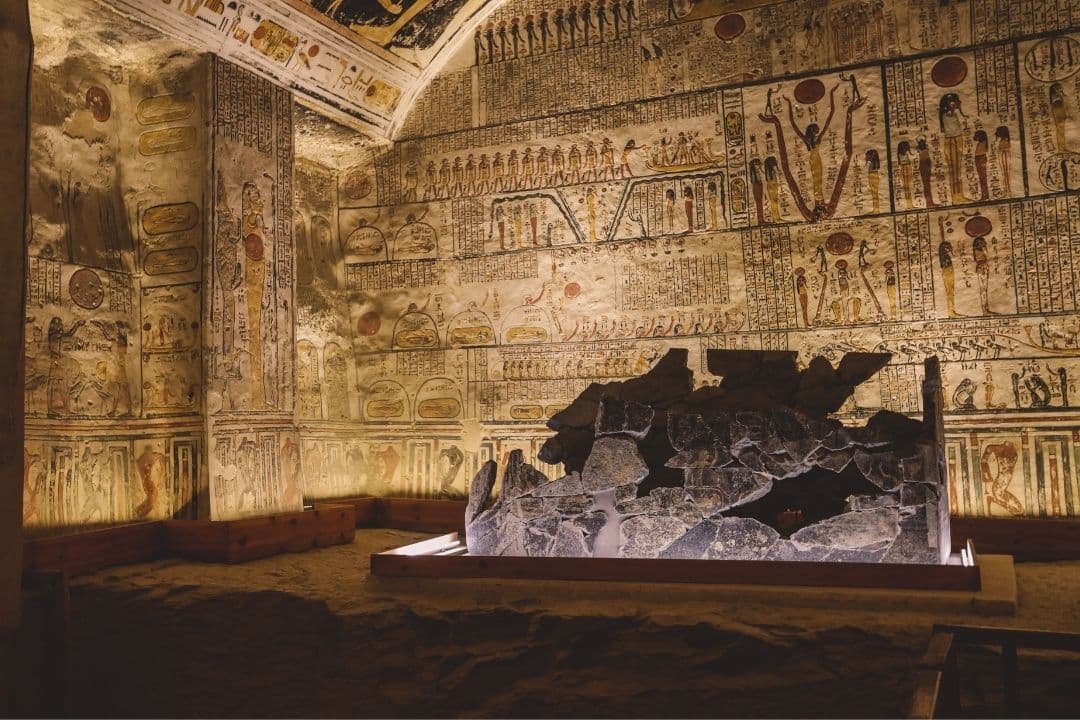
For forty years in the desert, every pair of hands that touched that sarcophagus was reminded of the same thing: God keeps his word. There was no preacher, no message, no sermon delivered from a platform. There was just a box, and what it represented, and the unbroken chain of custody running from a dying man's request to a promised destination.
The resolution comes in Joshua 24:32. They buried those bones in Shechem, in the land Jacob had purchased, in the very region where Joseph's brothers had been tending their flocks when his father first sent him to check on them. That's where the betrayal began. That's where the pit happened. And that's where Joseph came home, four hundred years later, to the specific piece of ground where everything started. The circle closed. The promise landed exactly where God said it would.
There is something of that in what followers of Christ do at the Lord's table. Paul wrote in 1 Corinthians 11:26 that every time we eat that bread and drink that cup, we proclaim the Lord's death until he comes. The table is its own silent sermon: he died, he rose, and he is coming back. Week after week, we carry our own box of bones forward, trusting a destination we haven't reached yet.
Nobody Drifts to a Strong Finish
Joseph died with his faith intact, his bitterness absent, and his hope undiminished after a life that included betrayal, slavery, false accusation, and years of unjust imprisonment. He didn't arrive there by accident. Nobody does.
Paul put it plainly near the end of his own life: "I have fought the good fight, I have finished the race, I have kept the faith" (2 Timothy 4:7). He didn't say the race was easy. He said he finished it. Hebrews 12:1-2 frames the same truth as a direct call: throw off what hinders, run with endurance the race marked out for you, and fix your eyes on Jesus.
Fix your eyes on Jesus. Not on Egypt.
Whether life right now feels like a pit or a palace, the same five words apply. They're a reminder that this isn't home, that the promises are real even when their fulfillment feels distant, and that the faith of people who came before us still speaks to anyone willing to listen.
Don't bury me in Egypt.